Solving the sand shortage in key projects
Currently, many key projects across the country are lacking in foundation sand and construction sand, seriously affecting the project's progress. Many businesses have to find every way to find a supply source, even accepting higher costs, to avoid project delays.
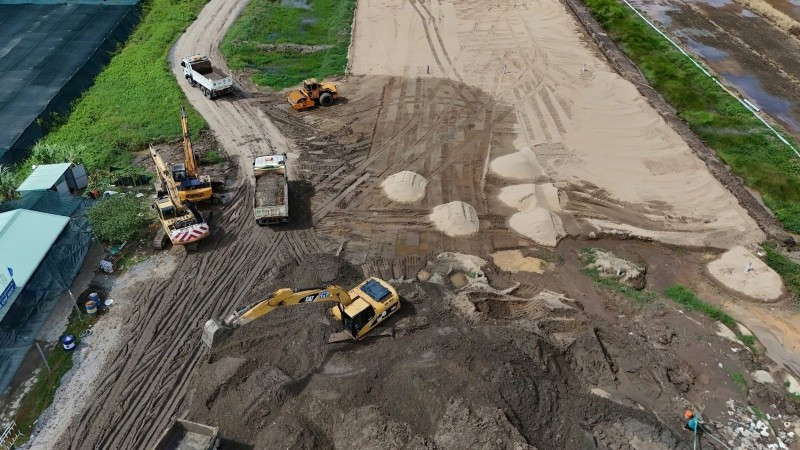
Construction Package 8 of the Ho Chi Minh City Ring Road 3 project, passing through Hoc Mon district, in the west of the city, is in need of a large amount of sand for foundation filling. (Photo: THE ANH)
Lack of resources, increasing prices
At the construction site of Construction Package 8 of the Ho Chi Minh City Ring Road 3 project (in Hoc Mon district), the dump trucks carrying sand are always welcomed by staff and workers as... "rescue vehicles" to slow down the progress.
A manager of Cienco 4 Company - the construction unit - said that for nearly a week, the unit had to speed up construction, so it was forced to buy imported sand from Cambodia, accepting a price about 30% higher than the domestic sand price. Currently, about 70% of the sand the unit uses is imported sand, only 30% from the country. If it cannot buy in time, the unit will have to wait for each truck of sand to drop by the Mekong Delta.
A similar situation also occurred in the Construction Package 6 (Cu Chi District) undertaken by Truong Son Construction Corporation. According to Mr. Hoang Tung, in charge of the project, the unit needed about 300,000 m³ of sand to serve the construction of bridges, roads and tunnels.
Due to urgent needs, the company was forced to buy Cambodian sand at a price of nearly VND400,000/m³ - about VND100,000/m3 higher than the domestic price. “Every day we have to import about 600-1,200 m³ of sand to ensure progress. Domestic sand is too scarce, so the only way left is to buy from Cambodia,” said Mr. Tung.
According to contractors, in addition to importing, many units are looking forward to receiving specific instructions from the Ho Chi Minh City government on opening a “green channel” for sand transportation, in order to shorten transportation time, save costs and speed up project construction progress.
In the central region, the supply of construction sand is also extremely scarce. Records in Quang Nam province and Da Nang city show that, although entering the peak construction season, sand prices have skyrocketed, while many projects have yet to find a stable supply. At the Suoi Tho reservoir project (Tien Phong commune, Tien Phuoc district, Quang Nam province), the contractor is "racing" against time to complete key items such as spillways, water intake culverts, etc. before the 2025 flood season.
Mr. Nguyen Van Tan, Director of Khue Trung Joint Stock Company - the construction unit - said: "When the contract was signed, the price of sand was 290,000 VND/m³, but now the price has increased to 570,000 VND/m³ and there is still no sand to buy. We cannot delay the progress because this is an important irrigation project. If the flood comes and it is not completed, all efforts will be washed away by the water flow".
According to Mr. Nguyen Ngoc Tan, Deputy Director of the Quang Nam Provincial Construction Investment Project Management Board, Suoi Tho reservoir is a level II project with a total investment of VND150 billion, serving irrigation for 400 hectares of agricultural land in Tien Phong and Tien My communes. The project will be implemented from 2023 to 2026, but the biggest difficulty at present is the sharp increase in material prices, especially sand, while the supply is seriously lacking.
Need to join hands to solve the problem
According to the Ho Chi Minh City Traffic Construction Investment Project Management Board, the total demand for sand for the Ring Road 3 project through the city is about 6.6 million m³. However, by the end of May, only 2.5 million m³ had been supplied, meaning there was a shortage of 4.1 million m³. “Every day, we need about 17,000 m³ of sand for filling the foundation. If we are not proactive, it will be very difficult to complete the goal of technical traffic opening of the entire route by December this year,” said Le Ngoc Hung, Deputy Director of the Project Management Board.
To overcome the difficulties, Ho Chi Minh City leaders have urgently directed the opening of a “green channel” to prioritize sand transportation, avoiding duplicate inspections that cause delays. At the same time, the city has asked Tien Giang, Ben Tre, and Vinh Long provinces to support the exploitation and transportation of sand from licensed mines to serve the Ring Road 3 project.
In Quang Nam, the three localities with the largest sand reserves are Dai Loc and Duy Xuyen districts and Dien Ban town because they are located on the Vu Gia-Thu Bon river system. However, most of the mines here have expired mining licenses. Many new sand mines, although included in the planning, have not been licensed for exploitation, making it impossible for the supply to increase in the short term.
Nguyen Tuan Phong, Deputy Director of the Quang Nam Province Traffic Construction Project Management Board, said that the estimated price of sand is 180,000 VND/m³, but in reality, contractors are having to buy it at 300-400,000 VND/m³, even up to more than 600,000 VND/m³ in some places. Although the contractors have been instructed to try to comply with the contract, and at the same time, they have increased encouragement and support for construction, so far there has been no fundamental solution to the sand shortage.
Da Nang City is also affected by the closure of sand mines in Quang Nam. According to the report, the current supply of construction sand in Da Nang mainly depends on the three above-mentioned localities of Quang Nam. When these mines stop operating, the price of materials in Da Nang also "escalates". Although contractors accept to buy at high prices, there are still many times when there is no goods to buy.
Faced with this situation, on May 27, Vice Chairman of the Da Nang People's Committee Le Quang Nam sent a document requesting Quang Nam province to urgently check, update and adjust the price of construction materials in accordance with the provisions of Circular No. 01/2025 of the Ministry of Construction. In case there is no need for adjustment, Quang Nam is requested to send a written response so that Da Nang has a basis to inform relevant parties.
In the long term, there needs to be a fundamental and thorough solution to overcome the shortage of construction sand. Currently, many enterprises have invested in stone crushing lines to make artificial sand for construction materials.
Vice President of the Vietnam Association of Construction Materials Pham Van Bac
According to Vice President of the Vietnam Association of Construction Materials Pham Van Bac, in the long term, there needs to be a fundamental and thorough solution to overcome the shortage of construction sand. Currently, many enterprises have invested in stone crushing lines to make artificial sand for construction materials.
Previously, the price of artificial sand was often higher than the price of natural sand, so it was difficult to sell, but now due to high demand, the price of crushed sand is equal to, or even lower than, the price of natural sand depending on the time. At the same time, the production capacity of artificial sand in some localities can also partially meet the demand for construction sand with many types.
In fact, artificial sand has been used in many national key projects in the past such as: Son La Hydropower Plant, Lai Chau..., where there is no available and sufficient source of natural sand and in some types of concrete, pre-mixed dry mortar... to build civil works. Therefore, promoting the use of artificial sand will help "share the burden" for the need to use sand in general and sand for filling in traffic in particular. The current problem is that people do not have the habit of using artificial sand in housing construction.
More than ever, to solve the problem of supplying construction materials, especially sand for filling in key projects, requires the drastic and synchronous participation of ministries, functional branches and localities where there are mines. It is necessary to promptly remove the "bottlenecks" in planning, licensing, exploitation and transportation to ensure a stable and sustainable supply.
Only with close and effective coordination from the central to local levels can the progress of key national projects be accelerated.
Source: Nhan Dan Newspaper.
-
Share:
-

-

-

-

Featured Articles